I downloaded six breathing apps. They all do the same thing: a circle expands (inhale), holds (hold), contracts (exhale). The timing is fixed. Box breathing is always 4-4-4-4. The 4-7-8 technique is always 4-7-8. Coherent breathing is always 5 seconds in, 5 seconds out.I tried the 4-7-8 technique for sleep. Four seconds isn't enough for me. I fill my lungs in three. The hold feels short. The exhale is fine but I could go longer. The pattern doesn't fit my body; it fits Dr. Andrew Weil's recommendation from 1998, applied identically to every person who downloads the app.This is a timer, not a trainer. A trainer would ask: where are you right now? And where do you want to be?
What Progress Looks Like
Every technique in Breathe has five levels:Box Breathing at Level 1 is 3-3-3-3. Twelve seconds per cycle. That's where someone who's never done breath training starts. Level 2 is 4-4-4-4, the standard you see everywhere. Level 3 is 5-5-5-5. Level 4 is 6-6-6-6. Level 5 is 8-8-8-8, thirty-two seconds per cycle. That requires genuine breath control.4-7-8 at Level 1 is 3-5-6. Can't hold your breath for seven seconds? Start where you can. Level 5 is 8-14-16. That's a 38-second cycle with a 14-second hold. Nobody gets there on day one, and no other app builds you toward it.The app sets your current comfortable level (or tests it on first launch), you set your target, and it generates a progression plan. Three comfortable sessions at a level earns you the next one. Simple. Measurable. Progressive.
The Altitude Gap
I trek in the Himalayas. Annapurna, Langtang, the routes that take you above 4,000 meters where the air is 40% thinner and your lungs become the limiting factor.At altitude, you don't need "calm breathing for stress relief." You need techniques that increase oxygen transfer and reduce the CO2-driven panic that makes you gasp:Pressure breathing. Force the exhale through pursed lips. This increases air pressure in your lungs, pushing more oxygen into your bloodstream when the ambient pressure is working against you. Every mountaineering manual teaches it. No app does.Double inhale (physiological sigh). Two quick inhales before a long exhale. The second inhale pops open collapsed alveoli in your lungs, air sacs that a single inhale misses. Stanford's 2023 RCT proved it outperforms meditation for stress reduction. I've used it at 5,000 meters to recover from altitude headaches.Huffman breathing. Short, forceful exhales through the mouth. Generates internal heat through rapid diaphragm engagement. Used in cold altitude exposure. Not taught in any app because no app is built by someone who's needed it.CO2 tolerance training. Your body panics at CO2 buildup, not low oxygen. The gasping reflex at altitude is your brain overreacting to CO2, not a sign that you're out of air. Progressive breath-hold training teaches your body to tolerate higher CO2 levels, which means less panic, steadier breathing, and better acclimatization.Nepal sees 200,000+ trekkers a year. Add Kilimanjaro, Patagonia, the Colorado 14ers, and the Andes: millions of people go to altitude annually. Not one breathing app prepares them.
The Programs
Four structured multi-week plans, not just technique menus:Trek Prep (4 weeks). Designed for Annapurna Base Camp, Everest Base Camp, Kilimanjaro, and similar. Week 1 builds the diaphragmatic foundation and tests your CO2 tolerance baseline. Week 2 introduces pressure breathing and pursed lip technique. Week 3 progressively builds CO2 tolerance and adds Wim Hof rounds. Week 4 combines everything at extended durations. Start this a month before your trek.Sleep Protocol (2 weeks). Starts with 4-7-8 at YOUR level, progresses nightly, then adds coherent breathing and cyclic sighing so you find the technique that works for your specific body.Stress Resilience (3 weeks). Box breathing progression from 3-3-3-3 to 6-6-6-6, with the physiological sigh as an emergency tool you can deploy in seconds.Cold Exposure Prep (2 weeks). Wim Hof rounds progression plus Huffman breathing for cold plunge enthusiasts and winter athletes.
The Design
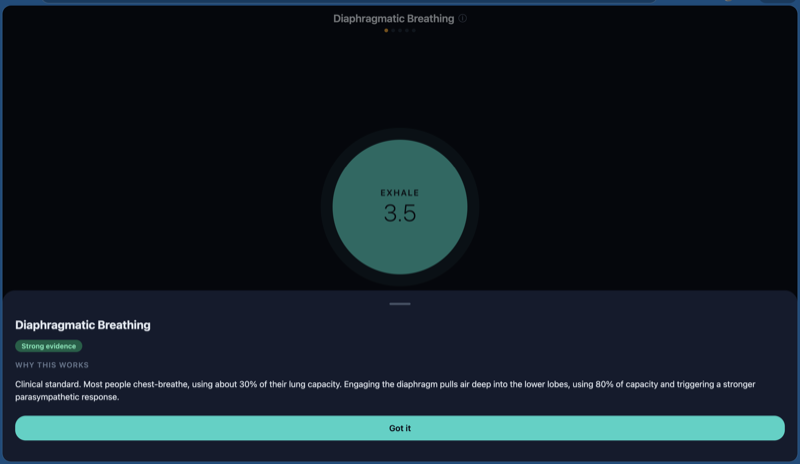
One screen. One circle. The circle expands when you inhale, contracts when you exhale, and glows during holds. That's the entire visual interface.A haptic pulse marks each phase transition. You can close your eyes, lie in bed, or stare at the ceiling of a tea house at 4,200 meters. The vibration tells you when to breathe.No account. No internet required. Everything runs locally. This isn't just a business decision; it's a design constraint. A trekker at Thorong La Pass (5,416m) has no cell signal. The app has to just work.
The Science Cards
Each technique has a one-paragraph "why this works" explanation in plain English. Not citations. Not jargon. Just the mechanism:
Box Breathing: Equal-length phases give your brain a predictable rhythm. Predictability activates the parasympathetic nervous system (rest-and-digest). Your heart rate syncs to the breathing cycle within 2-3 minutes. The military uses this because it works under fire, not just on a yoga mat.
Physiological Sigh: Your lungs have ~480 million alveoli (tiny air sacs). Some collapse during normal breathing. The double inhale reinflates them. More open alveoli means more surface area for oxygen transfer. The long exhale activates the vagus nerve, which slows your heart. Stanford tested this against meditation: the sigh won.
If you don't understand why a technique works, you won't know when to use it. And if all you have is a menu of patterns with no guidance, you're back to guessing.
Revenue Model
Free with a small banner ad on the home screen. Never during a breathing session. Five core techniques available for free, with progression.$4.99 one-time purchase removes all ads, unlocks the full technique library (15+ techniques), all four programs, custom pattern builder, and detailed stats.No subscription. Every other breathing app either charges $15/month (Wim Hof), $49/year (Breathwrk), or $130/year (Othership). Users are revolting against subscription fatigue for what amounts to a timer. Five dollars, once, forever.Stack: Expo 55, React Native, TypeScript, Reanimated, expo-haptics, expo-av, AsyncStorage. Offline-first.