
Skip to content
Projects

Chopin Was Right. Everyone Else Was Wrong.

Side Project
Primary linkOpen live apphttps://chopins-touch.vercel.app
Chopin Was Right. Everyone Else Was Wrong.
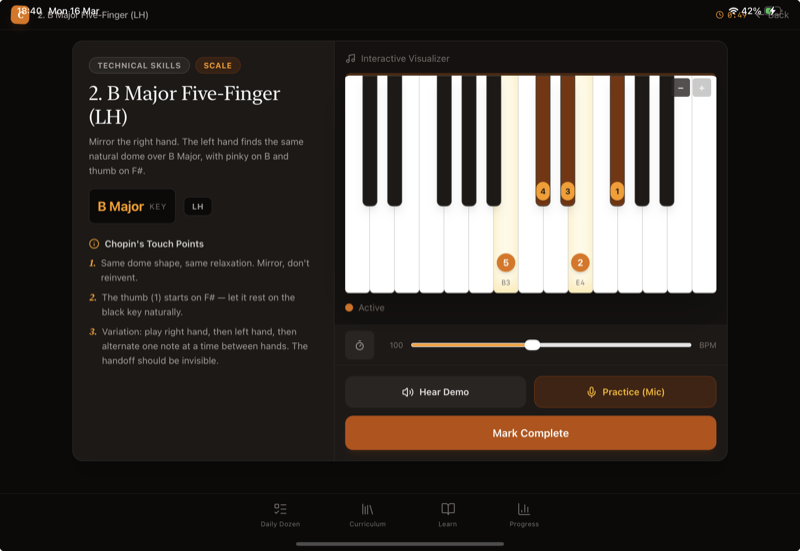
Every piano method published since Czerny starts with C major. All white keys. No sharps, no flats. Simple to read, simple to explain, and completely wrong for the human hand. Look at your right hand. Fingers 2, 3, and 4 are longer than 1 and 5. Now place them on a piano keyboard in C major position: all five fingers on white keys, all at the same height. Your longer fingers have to curl down to meet the same surface as your shorter ones. Your wrist flattens. Your hand tenses. You've been fighting your own anatomy before you've played a single note. Chopin saw this. In his Projet de methode (drafted around 1839, never published in his lifetime), he argued that B major is the natural starting position. In B major, fingers 2, 3, and 4 fall on black keys, which sit higher. Your longer fingers rest on higher keys. Your shorter fingers (thumb and pinky) rest on lower white keys. The hand finds its natural arch without effort. This is documented. Musicologists have written about it. Piano teachers have read about it. And then they all go back to C major, because that's how they were taught, and that's how the textbook is printed. I built a piano app that starts with B major.
Chopin's pedagogy wasn't just "different key, same exercises." His entire philosophy diverged from the conservatory tradition: Singing tone first. Before technique, before scales, before anything: make the piano sing. Chopin called it cantabile. The piano is a percussion instrument that pretends to be a voice, and the player's job is to maintain the illusion. Every exercise in Chopin's Touch starts with tone quality, not speed. Finger individuality. Czerny and Hanon treat fingers as interchangeable pistons. Chopin treated each finger as having its own character: the thumb is lateral ("moves like a crab"), the fourth finger is naturally weak and needs specific training, the fifth finger is small but capable of surprising power. The app trains each finger independently before asking them to work together. Expression from day one. Most methods save dynamics (loud/soft, fast/slow, sustained/staccato) for intermediate students. Chopin taught them from the first lesson. His students didn't learn to play notes and then learn to play musically. They learned to play musically from the start, because playing without expression is not playing.
I'm autistic. Expression in music, like expression in speech, was something I could perform mechanically but couldn't feel intuitively. When a teacher said "play this passage more tenderly," I understood the word but not the instruction. Tender how? Softer? Slower? Both? By how much? Chopin's Touch makes dynamics explicit. Velocity is a number (how hard you press). Sustain is a duration. Articulation is the gap between notes. "Play it more tenderly" becomes: reduce velocity by 15%, increase sustain by 200ms, overlap notes by 50ms. Those are instructions I can follow. Those are instructions I can practice until the mechanical execution starts to feel natural. This is the same principle behind every app I build: take the implicit channel (the one that neurotypical people absorb unconsciously) and make it explicit (measurable, trainable, progressive).
The app runs on iPad. You tap a note on the on-screen keyboard or play it on a connected MIDI keyboard. The app shows you what to play next (falling notes, sheet-style, or highlighted keys), listens via the microphone or reads MIDI input, and tells you whether you're right. But "right" isn't just the correct pitch. The app also evaluates:
  • Dynamics: Are you playing at the indicated volume? Piano means soft. Forte means loud. Mezzo-forte means medium. These are numbers, and the app shows you where you are on the scale.
  • Timing: Are you rushing? Dragging? The metronome is drift-free (Web Audio look-ahead scheduling), and the app shows your actual timing against the target.
  • Fingering: Each note has a recommended finger. The app displays it. If you're using MIDI, it can detect which finger you're using.
The daily routine follows Chopin's actual lesson structure: natural position exercises first (B major, hand shape, thumb movement), then technique (scales, arpeggios, finger independence), then musicality (dynamics, phrasing, expression).
Twelve pieces, progressing from beginner to advanced: Ode to Joy. Twinkle Twinkle (with variations). Bach Prelude in C. Mozart's Rondo Alla Turca. Chopin's Nocturne Op.9 No.2. Debussy's Clair de Lune. Each with sections, each section with specific fingerings, each fingering with a reason rooted in Chopin's approach. The pieces aren't simplified pop songs. They're the repertoire that teaches you to play expressively, chosen because each one demands something specific: legato phrasing, hand crossing, dynamic contrast, rhythmic independence.
The interesting thing about building a piano teaching app is that the hard problem isn't detecting notes. Pitch detection with autocorrelation is straightforward. The hard problem is: what does "good" sound like, and how do you communicate that through a screen? Every competitor (Simply Piano, Flowkey, Yousician, Piano Marvel) answers this with gamification: green for right, red for wrong, score at the end. Binary. You either hit the note or you didn't. Chopin would have hated this. A note can be correct in pitch and completely wrong in everything else: too loud, too short, too mechanical, played with the wrong finger, attacked instead of sung. Music isn't binary. Teaching it as if it were produces students who can hit notes and cannot play piano. I don't claim to have solved this. But starting from Chopin's framework instead of Czerny's, and making dynamics as visible as pitch, gets closer to what "learning piano" actually means. Stack: React 19, Vite 6, TypeScript, Tailwind v4, Capacitor 8, Web Audio API (3-layer synthesis), MIDI input, autocorrelation pitch detection.