Skip to content
Projects

The Polymath's Minimum Viable Day

Side Project
Primary linkView on GitHubhttps://github.com/BipinRimal314/Habit-Tracker
The Polymath's Minimum Viable Day
Most habit trackers assume the problem is motivation. Download the app, set your goals, get your dopamine hit from checking boxes. Three weeks later, the app is buried on your fourth home screen. That diagnosis is reasonable. For most people, it might even be right. But it misses a subtler failure mode, the one I live in. I'm an INTP 5w4. I don't lack motivation. I lack a threshold low enough to cross. The 5's instinct isn't laziness. It's preparation. Read one more paper before you start the ML project. Watch one more tutorial before you touch the piano. Understand the biomechanics before you attempt the L-sit. The research feels productive. It isn't. It's the most sophisticated form of procrastination I know. I wanted to grow across four domains simultaneously: machine learning, music, body, mind. The conventional wisdom says pick one thing and go deep. I respect that advice. It's also wrong for the way my brain works. The cross-domain transfer is where my best thinking happens. The question was never "should I pursue all four?" It was "what system makes all four possible without burning out?"
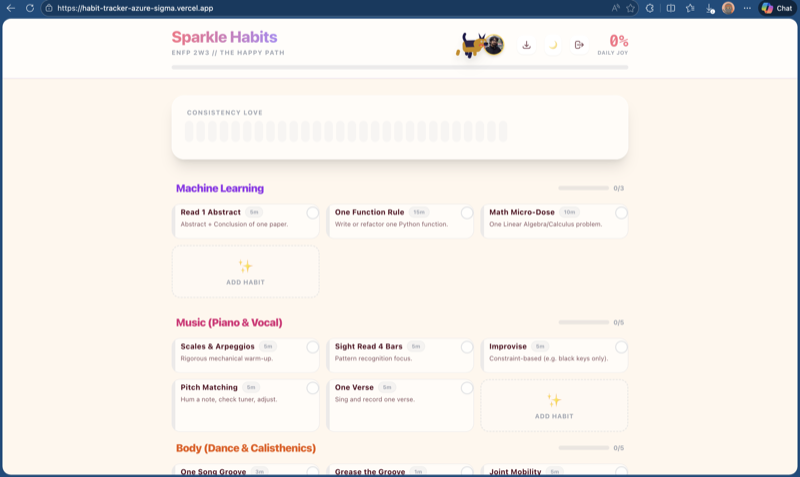
The answer turned out to be embarrassingly simple. Five minutes. The Slight Edge thesis: small daily actions compound in ways that are invisible day-to-day but undeniable over months. The corollary nobody states explicitly: the minimum effective dose for compound growth is much lower than people think. You don't need an hour of piano practice. You need fifteen minutes, every day, for a year. So I micro-dosed every habit. Sixteen habits across four domains, none longer than fifteen minutes:
  • Machine Learning: Read one abstract (5 min). Write one function (15 min). One math problem (10 min).
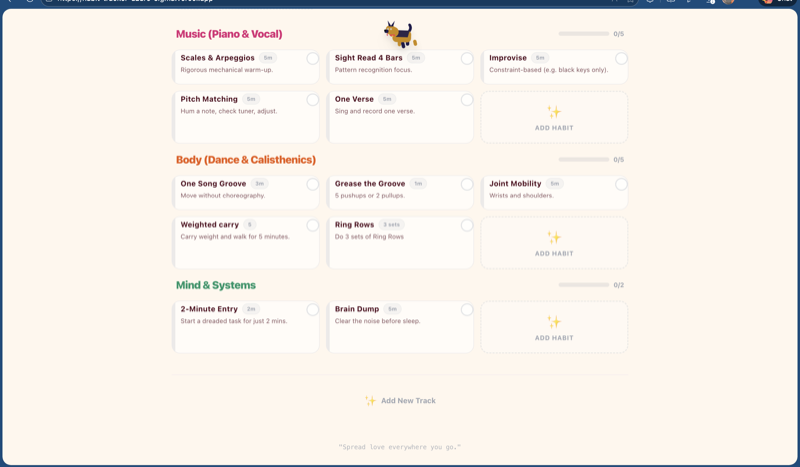
  • Music: Piano (15 min). Singing (15 min).
  • Body: Dance (10 min). Calisthenics (15 min).
  • Mind: Systems thinking (10 min).
The bet: showing up matters more than duration. A five-minute abstract is infinitely more than zero abstracts. And once you start, the 5's hyperfocus often carries you past the timer anyway.
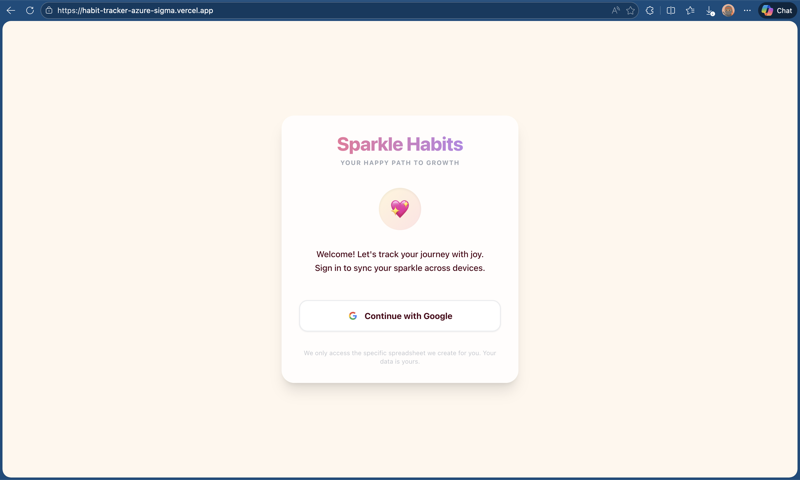
React 19, TypeScript, Vite 7. Tailwind CSS with a custom color palette I called enfp. Ironic for an INTP, but the warm tones make me want to open the app. That matters more than it should. Google OAuth 2.0 with Google Sheets sync for cloud backup. No database to manage, no infrastructure to maintain. My data lives in a spreadsheet I own. localStorage handles persistence between syncs. The heatmap is the centerpiece. Not because heatmaps are novel (they aren't), but because the compound pattern is invisible without one. Day three looks identical to day one. Day ninety doesn't. You need the visual proof that the slight edge is working, especially on the days when it doesn't feel like it is. There's a RunningDog companion animation. It's unnecessary. I kept it anyway. Sometimes the thing that gets you to open the app isn't the feature set. Dark and light mode. The usual.
This isn't a generic habit tracker with configurable defaults. The habits aren't user-defined. They're a curriculum (my curriculum) for becoming uncategorizable. Four domains. Sixteen specific practices. Each one chosen because it develops a capacity that transfers to the others. ML sharpens pattern recognition. Piano develops motor learning and patience. Calisthenics teaches progressive overload: the same principle that makes compound growth work everywhere else. Systems thinking connects all of them. A generic tracker would let me add "drink water" and "read before bed." That's fine for someone else. I needed a tool that held me to the specific version of growth I'd committed to.
The habits are hardcoded. That was intentional; I didn't want the overhead of configuration to become another form of procrastination. But it means no one else can use this without forking it and rewriting the habit list. If I deploy it publicly, I'll need to solve that without losing the opinionated defaults that make it work. The Google Sheets sync is functional but brittle. OAuth token refresh edge cases still surface occasionally. I'd move to a proper backend if this were anything other than a personal tool.
Functional. In daily use. Open source, MIT licensed. Source: GitHub | License: MIT